Pixie: a chat for recruiters in a hurry
Recruiters don’t read a portfolio top to bottom. They come with a few questions and a few minutes. So I added Pixie, a small AI chat that answers from what’s on this site, admits when it doesn’t know, and points to my inbox. Try it: it’s the pixel speech bubble in the bottom-right corner.
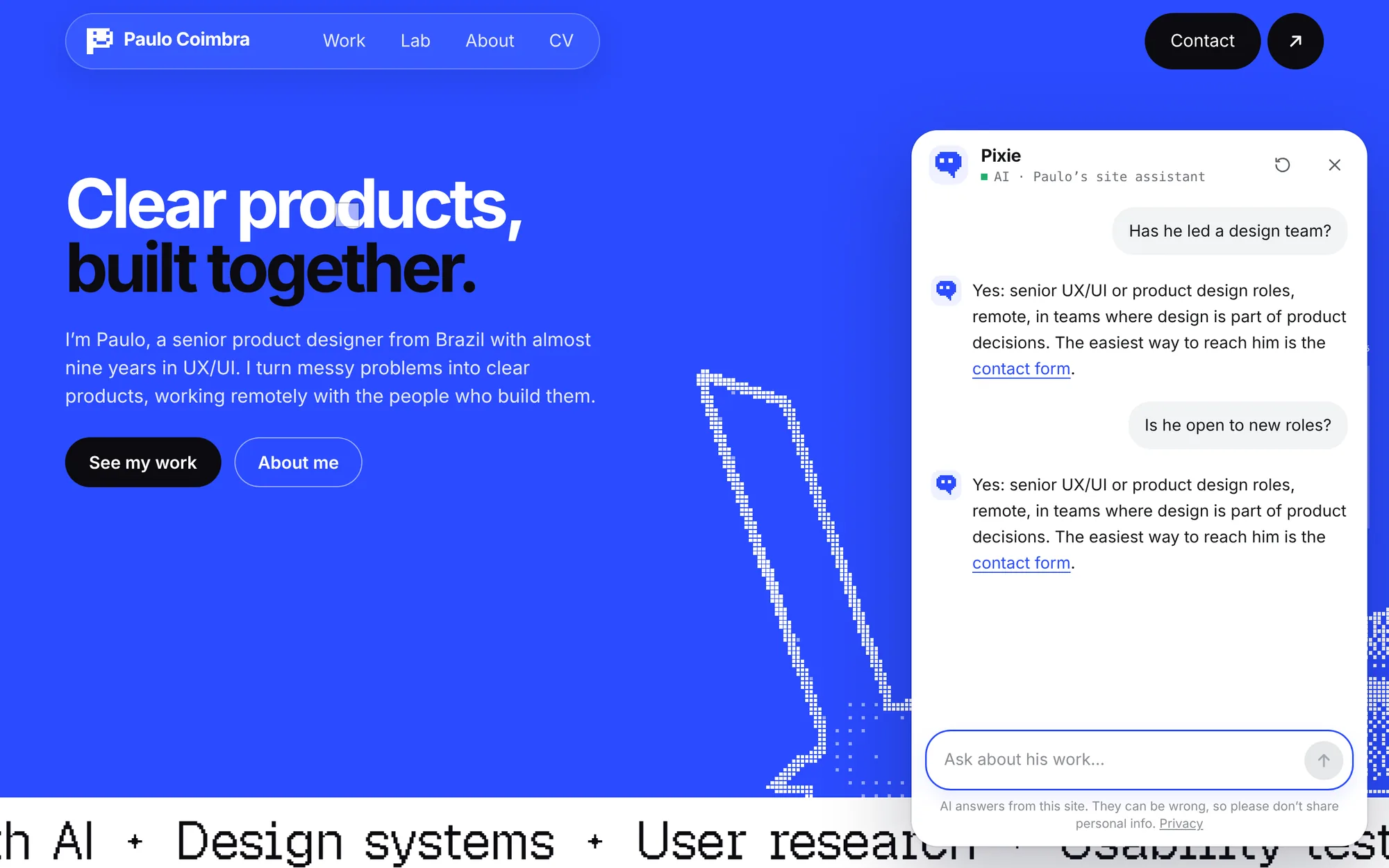
Let recruiters and hiring managers get quick answers about my work, and reach me when the site doesn’t have one.
Designed the chat, its voice and every fallback, and set the guardrails that keep it free, private and on topic.
Live and collecting data. I’ll publish the numbers after the first few weeks, good or bad.
Objective
Recruiters and hiring managers come with specific questions: is he open to new roles, will our hours overlap, has he led a team, how does he use AI? The objective is to let them get those answers without hunting through pages, and to make it easy to reach me when the site doesn’t have the answer.
This page follows the same format I use for every spec: objective, hypothesis, assumptions and key results.
Hypothesis
If visitors can ask, they’ll find answers faster than by scrolling, and more of them will get in touch.
Assumptions
What could be wrong:
- People may not use a chat on a portfolio at all.
- The AI may make things up about me.
- Someone may try to break it, or to run up a bill.
- A chat that only says “out of scope” feels like a dead end, and people leave.
Each one shaped a decision below.
Key results
If it’s close to zero after a month, the chat goes. A portfolio doesn’t need a feature nobody uses.
A low share means the site is missing answers recruiters want. Those become new content.
A high share means the suggested questions aren’t doing their job, so I change them.
Every question it couldn’t answer is a hint about what this site should say.
Each one comes with what I’ll do about it. No targets yet: I’ll set them once I know the baseline, from daily counts only, since no question text is stored.
How it’s built
How a question flows. Any failed check, limit or outage ends in a friendly fallback, never an error.
Zero cost, by design
The model runs on Groq’s free plan and the site on Cloudflare’s free plan, with no card on either. Going past a limit can’t create a bill: the service just stops answering, and the chat says it’s resting for the day.
Guardrails before the model
Every question is checked before it reaches the model: it has to come from this site, be 300 characters or less, and pass a Cloudflare Turnstile bot check. Each person can ask 5 questions a minute and 20 a day, and the whole site 300 a day, well under the free plan’s limit. A switch turns the chat off at any time.
It only knows what’s public
The assistant answers from one file with the facts already on this site. I wrote it assuming it will leak, so there’s nothing private in it. It can’t take actions or send anything, and it only links to this site and my profiles. Requests to change its role or reveal its instructions get a friendly redirect.
No dead ends
Every situation has its own reply, in the same voice: off-topic questions get a light answer and a few questions it can help with; questions the site can’t answer get my contacts; limits and outages get a short message and a way to reach me.
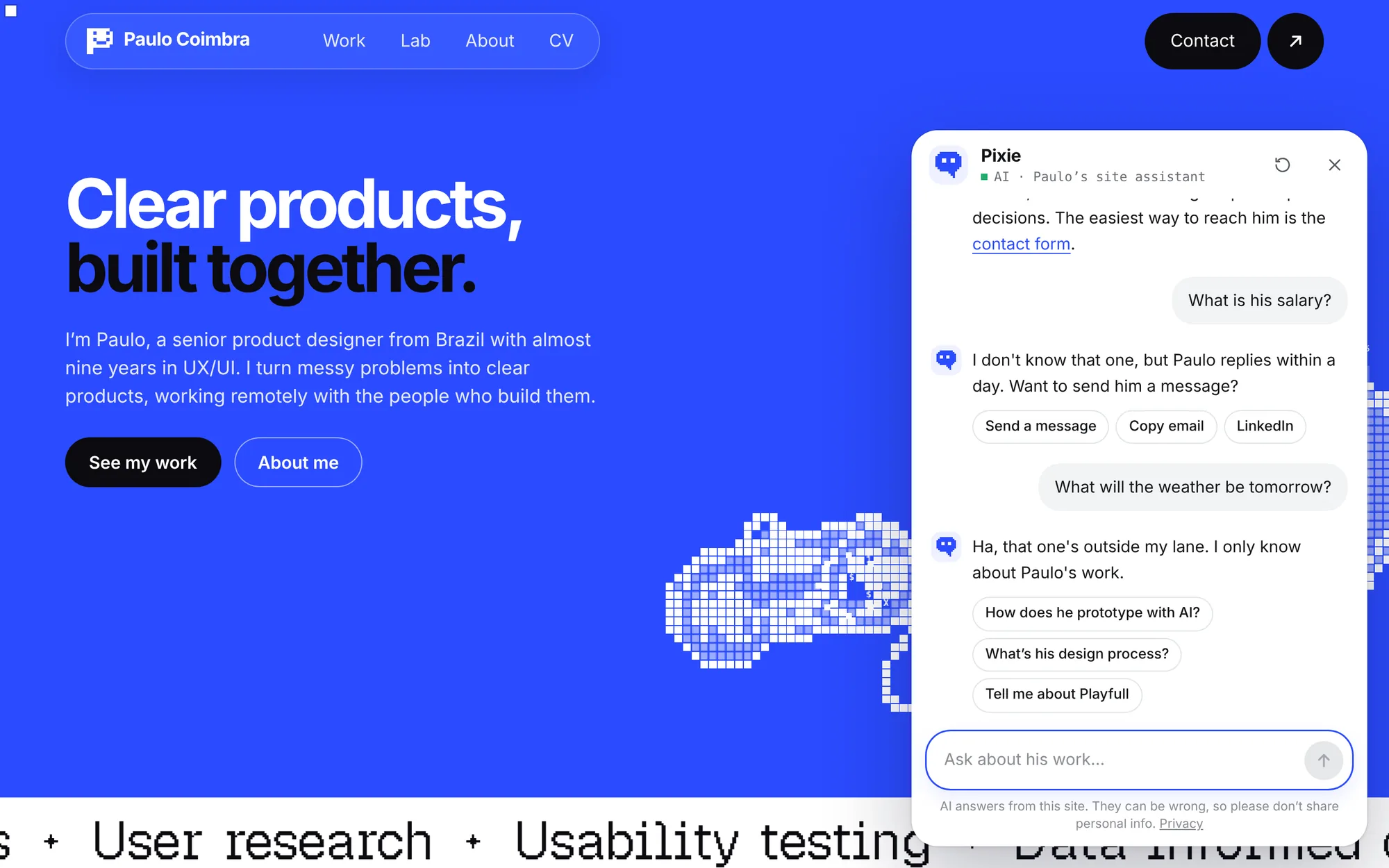
Two of the fallbacks: a question the site can’t answer, and one that’s off topic. Example conversation.
Nothing saved
Conversations live only in the browser tab. The site doesn’t store questions or answers, and Groq keeps nothing either, with zero data retention turned on. The limit per person uses a one-way code from the IP that changes every day and is deleted within 24 hours. The only numbers kept are daily counts by kind.
Next
After a few weeks I’ll fill in the key results and decide what changes: which questions it couldn’t answer, which should become content on the site, and whether the chat earns its place.